Projects · Georgetown gui²de
Kenya HealthFin Diaries
How households in Kenya pay for health care, recorded every couple of weeks rather than remembered once a year. I'm one of the data analysts on the study.
The HealthFin Diaries are a collaboration between FSD Kenya, Ekko Insights and Georgetown University's gui²de. Field researchers (RAs) visit the same households across nine counties and record every illness, clinic visit, SHA payment and shilling that comes in or goes out. Over a year that adds up to hundreds of thousands of cash flows.
Diaries data goes wrong in small ways that pile up. A new household member never gets a roster entry. A clinic visit has a cost but no provider. A cash flow is ten times the household's usual amount because someone added a zero. If nobody catches these within a week or two, the RA can't remember the visit and the household can't either. Most of my work is catching them early and making sure they get fixed.
Checks for each form
For each questionnaire form I write the review logic with the study lead, then a Stata do-file that applies it and writes a report per household into each RA's folder. The forms so far cover provider visits, SHA registration, the member roster, health issue registrations and updates, and cash flows.
The cash flow checks run against the full export. They flag amounts more than two standard deviations from the mean for that category and for that household, cash flows coded 99, broken links between related entries over time, and in-kind flows that need a second look.
Earlier, for the screening and baseline rounds on SurveyCTO, I ran the high-frequency checks and back-check comparisons in Stata.
The weekly correction cycle
A check is only useful if someone fixes what it finds. With the field supervisors we settled on a simple rhythm: issues go out to RAs on Monday, corrections are due by Saturday, and the following Monday I re-run the previous week's checks to confirm they were actually made. Spot checks get posted to a shared group so the whole team can see which problems keep coming back.
Before the September 2026 team meeting I prepared household-level outputs for every form and walked the RAs through them, so each person left knowing exactly which households needed a return visit.
Working on the study database
The diaries run on the Financial Diaries platform: a tablet app that syncs to a central MySQL database, with a FuelPHP web app called Query Builder for reporting. I don't have write access, so everything I build is read-only SQL.
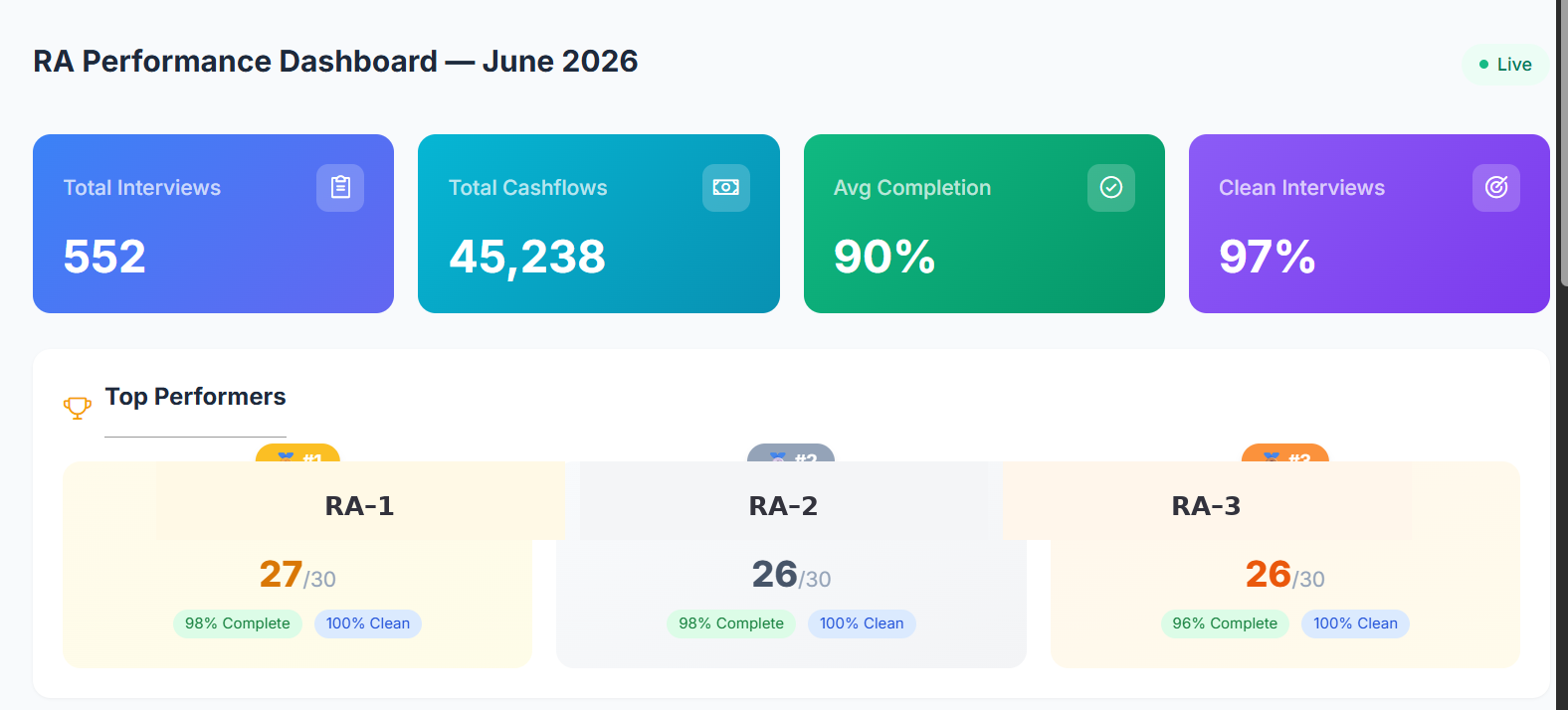
Inside Query Builder I built the high-frequency check pages, a set of one-click downloads for the Kenya study, and the RA dashboard. The cash flow download used to rebuild a pivot from every question each time, which was slow on a table this size. I wrote a faster version with fixed joins for the known follow-up questions that keeps the column headings the team already uses, with the old export as a fallback if it fails.
Scoring the field team
Each RA gets a monthly score out of 30. Half comes from the database: keeping to the visit schedule, completing forms, and how many quality flags their interviews raise. The other half is scored by supervisors: journal quality, how quickly they respond to feedback, and team participation. The top score is RA of the month.
The monthly completion and quality SQL behind it runs to about 3,000 lines. There is also a Streamlit version of the leaderboard, which reads from cached extracts and stores supervisor scores in Supabase.
Other pieces
- Took over the audio files, transcripts and tracking for the life history interviews, with scripts that check recordings and keep the tracker in sync.
- Built a Quarto dashboard for the February 2026 team retreat so the RAs could see what their own data showed: who the households are, what they spend on health, and how many have registered with SHA.
- Started the groundwork for a public data release in the style of DHS and IPUMS, beginning with a variable-by-variable audit of what could identify a household.
What stays private
Household records, names, locations and partner extracts stay inside the study. Everything on this page describes methods and tools, and the dashboard image has RA names removed.