Re:BUiLD Cash-Plus Targeting
Shiny recommender for IRC field teams — application layer from causal targeting models
Application development · Georgetown gui2de · IRC Re:BUiLD
From targeting models to a field recommender.
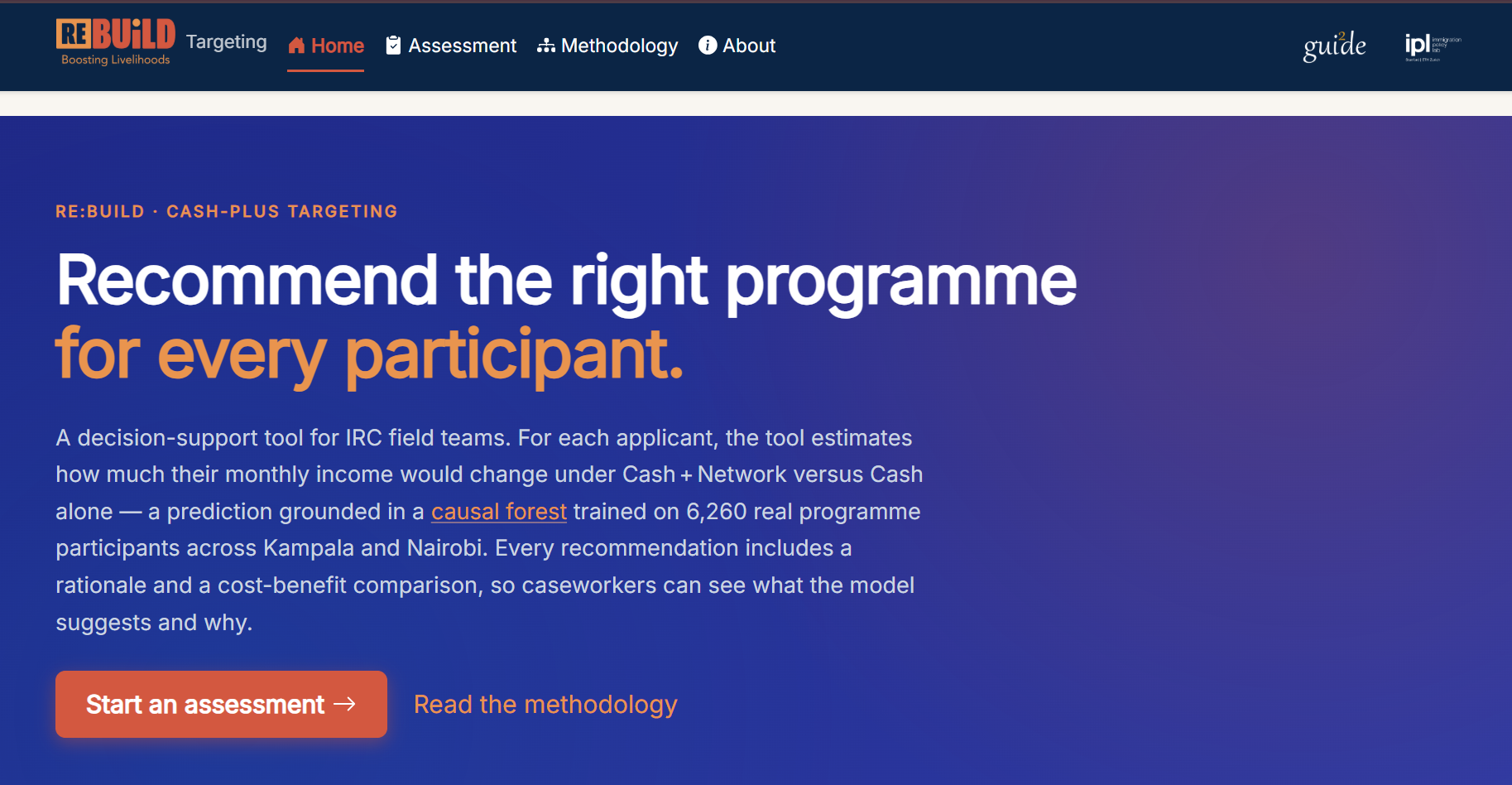
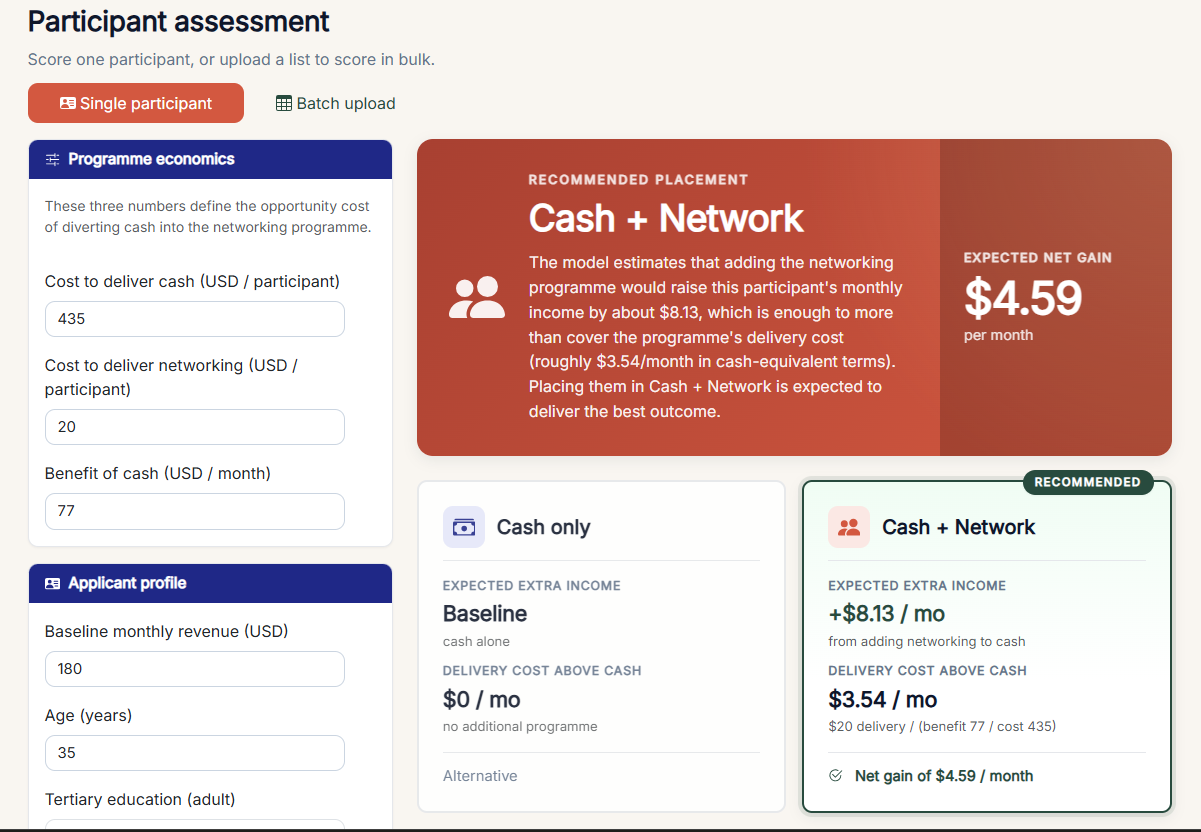
I built the Shiny application that turns gui2de cash-plus targeting analysis into a decision-support tool for IRC caseworkers: score one applicant or a batch, compare Cash only versus Cash + Network, and see a plain-language rationale with cost-aware economics.
My role (accurate credit)
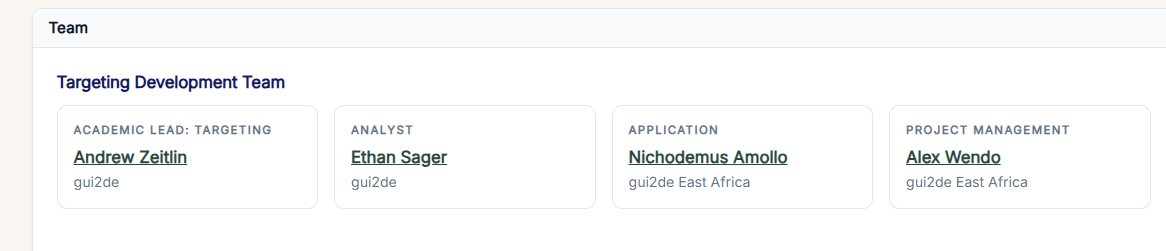
On the product’s Targeting Development Team I am listed as Application (gui2de East Africa): I developed the Shiny recommender from the targeting models so field teams could use the analysis operationally.
| Role | Person | Unit |
|---|---|---|
| Academic lead: targeting | Andrew Zeitlin | gui2de |
| Analyst | Ethan Sager | gui2de |
| Application | Nichodemus Amollo | gui2de East Africa |
| Project management | Alex Wendo | gui2de East Africa |
I do not claim sole ownership of the causal forest or the working-paper analysis. I claim the application layer: assessment UX, economics inputs, recommendation presentation, batch workflow, and deployment of a tool caseworkers can run.
Programme context
Re:BUiLD (Refugees in East Africa: Boosting Urban Innovations for Livelihoods Development) is a multi-year initiative led by the International Rescue Committee with support from the IKEA Foundation, pairing livelihoods services for refugee and host-community residents of Kampala and Nairobi with rigorous evidence generation. Georgetown gui2de supports the research and evidence layer.
Live tool: rebuild.shinyapps.io/rebuild-targeting
Problem the app solves
Average treatment effects hide real heterogeneity: networking helps some participants much more than others, and networking is more expensive to deliver than cash. Field teams need a participant-specific, cost-aware recommendation that still leaves the final call with the caseworker.
What the recommender does
- Enter a profile — screening characteristics (e.g. age, baseline monthly revenue, refugee status, language fluency, and related fields).
- See the prediction — estimated change in monthly income if networking is added to cash, weighed against delivery cost.
- Review with judgement — clear Cash only or Cash + Network recommendation with rationale and cost-benefit comparison.
Also supports batch upload so programmes can score a list of applicants, not only one-by-one.
Methods spine (for technical readers)
- Model family: causal forest (Wager & Athey;
grfin R)
- Estimand: conditional average treatment effect (CATE) of Cash + Network versus Cash only
- Training sample: 6,260 Wave 2 programme participants across Uganda and Kenya (Kampala and Nairobi)
- Decision rule (app logic): compare CATE to an opportunity-cost expression built from programme economics (cost of cash, cost of networking, benefit of cash)
- UX requirement: every recommendation needs a rationale and a cost-benefit comparison, not only a score
Caveats the product is honest about
- Recommendations are advisory; caseworkers keep final judgement
- Model fit is specific to the training contexts and waves; do not casually extrapolate to new countries without re-training
- Cross-site transport of targeting rules is a research concern, not something the app pretends is solved
- Use non-identifying participant IDs unless the deployment environment is approved for identifiable data
What this demonstrates
- Turning research models into field software under partner branding and real users
- Clear role boundaries (application vs academic lead vs analyst)
- Cost-aware causal targeting presented in language caseworkers can use
- Deployment discipline (Shiny, methodology tab, batch + single assessment paths)